System Design to Invoice Customers and Improve Cash Flow
- Company
- Nuvocargo
- Role
- Sr. Product Designer & Builder
- Date
- 2026
Context
A load could only be invoiced to a customer once it met certain criteria, such as being delivered to its destination and having a complete set of documents.
Problem
Cash flow is one of the most overlooked levers in freight brokerage. Brokers pay carriers shortly after delivery, while shippers can take 30 to 60 days to pay. Every day an invoice goes out late widens that gap.
At Nuvocargo, the finance team lacked a tool that showed which delivered loads were ready to be invoiced and which were still missing documentation.
Additionally, the experience wasn’t built for finance reps to quickly create invoices from within their workflow. It required going back and forth between interfaces.
Process
We started by understanding how the team was operating. Their tools were scattered, and some of the data was inconsistent. People on the same team worked with different tools, such as data dashboards and spreadsheets, because NuvoOS wasn’t giving them the visibility they needed.
From there, we defined the stages a load goes through before it’s ready to invoice.
Solution
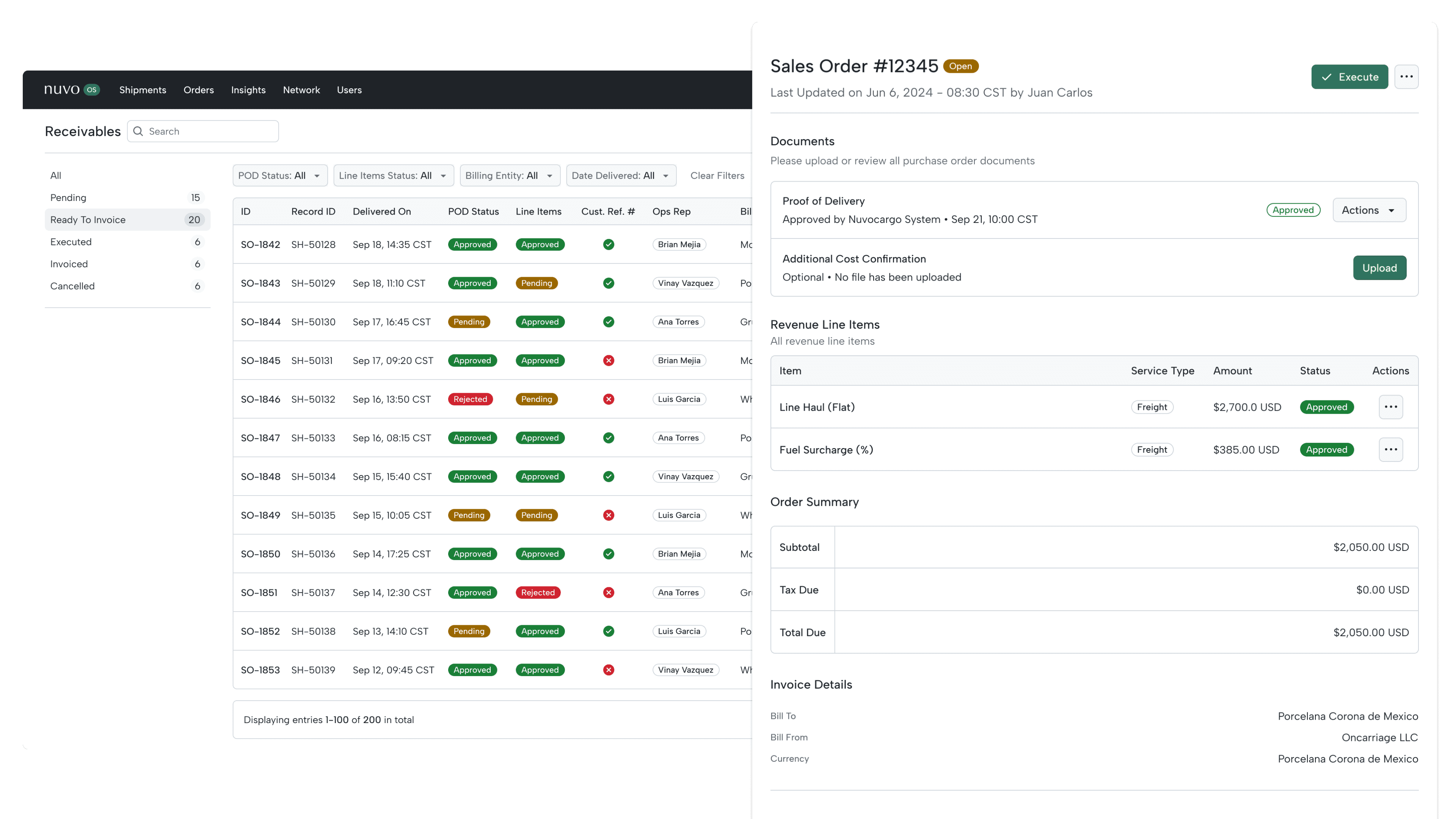
We redesigned the data tables with clearer stages and visibility into which invoicing requirements were met. We added new statuses and filters, reorganized the columns, and added a side panel for each Sales Order so reps could review and execute it quickly. For loads with defects, the team could see what was missing and who in the operation to follow up with.
I owned the end-to-end execution and deployment of this project using Piloto, our internal coding platform.
Outcome
Gave the finance team a single view of which loads were invoice-ready and made executing them a few clicks inside their workflow. Invoices went out sooner after delivery, narrowing the gap between paying carriers and getting paid by shippers.
“Thanks for the constant push you make with the operation to make the project succeed. I know working with the ops team can be really difficult, however sometimes we need a push from someone like you to make things happen. You were on top of the project since day one.”
Vision
This was the foundational phase of a larger effort to automate Sales Order execution once all the criteria were met, the same way we did for carrier Purchase Orders. At the time, customers had a wide range of invoicing preferences that our system hadn’t standardized yet, so standardizing them was the next step toward automation.